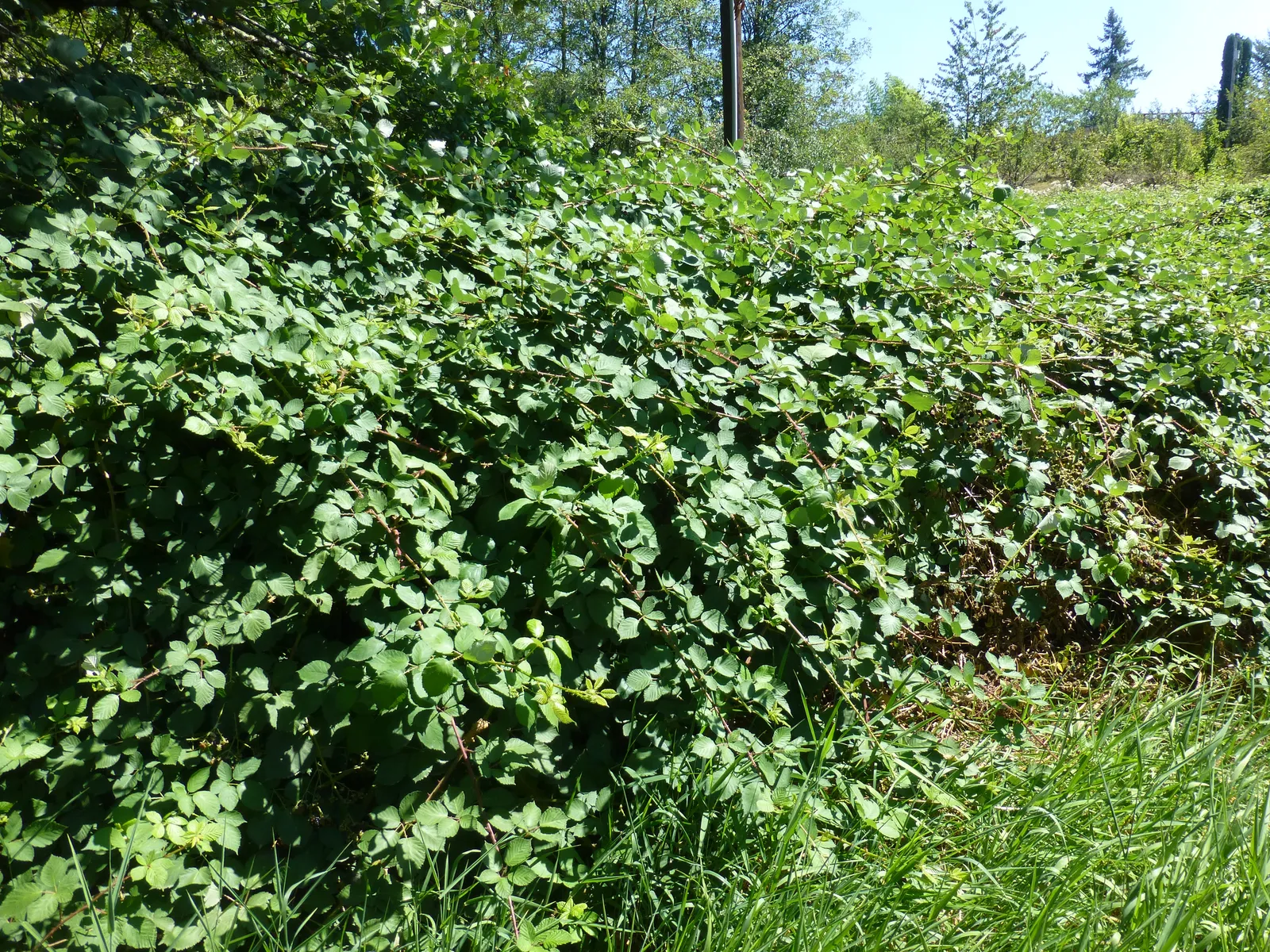
How Do You Get Rid of Himalayan Blackberry for Good?
You get rid of Himalayan blackberry by taking out the root crowns. Then you cut the regrowth on a schedule for two to three growing seasons. Cutting the canes alone will not do it. The plant lives below the ground, and the canes are only the part you can see.
The research is blunt about this. An Oregon State University Extension publication cites southwest Oregon field trials. Blackberry cut flat to the ground grew back to 41 inches tall within a year. Some canes reached 60 inches. A US Forest Service species review goes further and notes that a single cutting may even increase blackberry density.
Why does Himalayan blackberry grow back after you cut it?
The plant keeps its energy in a woody root crown, sometimes called a burl. The OSU Extension publication reports blackberry roots found 35 inches deep and up to 34 feet long. New canes push up from those crowns and roots from as deep as 18 inches.
That is why a mower alone does not finish the job. The blade takes the top growth and leaves the crown fed and untouched. Within weeks it sends up fresh canes on stored energy.
The crowns are also thick on the ground. In a study near Corvallis, root crown density averaged 3.3 crowns per square meter. That works out to thousands of crowns on a quarter acre. Real blackberry removal has to reach the crowns themselves.
How does it spread so fast in the Willamette Valley?
Blackberry got a long head start here. Oregon’s state weed profile says it was first noted here in 1922, in Marion County. It came to the Willamette Valley as a berry crop. It escaped and never left. The state now rates it the most widespread and economically disruptive noxious weed in western Oregon.
It spreads in more than one way at the same time:
- Cane tips root where they touch the ground and start a new plant.
- Root fragments left in the soil sprout on their own.
- Seeds ride out inside birds and land on clean ground.
The canes move fast. Oregon’s weed profile says stems often extend more than 20 feet in a season. The OSU publication puts single-season growth as high as 23 feet. One study cited by OSU followed a single cane cutting. It built a thicket 16 feet across in under two years.
Seed is the part most people miss. A dense thicket can drop up to 13,000 seeds per square meter. Robins and other songbirds carry them onto open ground. Those seeds stay alive in the soil for several years. Oregon’s weed program puts it plainly: any control plan is short-lived if it ignores the seed already in the soil.
The canes themselves live two years. First-year canes carry only leaves, second-year canes flower and fruit, and then they die standing. Those dead canes hold up the living ones, which is how a patch becomes a wall you cannot get through.
What actually works on Himalayan blackberry?
| Approach | What it does | What it takes |
|---|---|---|
| One cut or one mow | Opens the ground for a season | Regrowth averaged 41 inches in a year in OSU field trials |
| Repeat mowing only | Wears the root crowns down over time | Cutting every 2 to 3 weeks, spring through fall, for several years |
| Mulching the standing mass | Grinds canes to chips in place and leaves a cover layer | One machine pass, then a regrowth plan |
| Pulling crowns with a machine | Lifts much of the crown and root volume out | Moist, loose soil and a careful operator |
| Hand digging crowns | Thorough on small patches | OSU cites 300 to 1,000 hours per acre |
| Spraying | The step most published guidance pairs with cutting | Chemical application by a spray contractor |
Most published control guidance for Oregon pairs cutting with a herbicide such as glyphosate or triclopyr. Our work is mechanical instead. We take the mass off with machines and hold the ground with repeat mowing and mulching. We do not spray.
Does mowing kill blackberry?
It can, but only on a schedule and only over years. An OSU Extension guide says repeated mowing will kill a stand. That means every 2 to 3 weeks, spring through fall, over several years. The Forest Service review explains the reason: repeat cutting drains the energy the crowns have stored.
The OSU riparian publication sets the timing. Make the first cut early in the growing season. Cut again at flowering, or once regrowth reaches about 18 inches. That guidance says a rotary brush mower works well on flat and gently sloping ground. That fits most valley fields. Keeping a field on that schedule is what our brush hogging and field mowing work is for.
How does machine removal work on a blackberry field?
We start by grinding the standing mass down with a forestry mulcher head. That turns a thicket into a chip layer on the ground in one pass. OSU notes that fine mulched material is often best left in place. It holds soil moisture and slows weed seed from sprouting.
Then come the crowns. Our excavator runs a brush rake that grabs and lifts canes with the roots and crowns still attached. The OSU guidance for this method is to lift rather than cut. Stay within a few inches of the surface. Digging deeper severs roots, and severed pieces sprout.
Soil condition decides how well this goes. The publication says the method works best in moist, loose ground. It works far less well in dry, rocky, heavy clay or compacted soil. Valley clay-loam stays damp well into spring, which is usually the better window. Where a property is blackberry mixed with heavier growth, the job also becomes clearing thick brush and undergrowth.
What keeps a cleared field from going back to blackberry?
Occupied ground. Blackberry cannot handle deep shade, and OSU reports that its vigor and seed production drop as shade increases. Grass that comes back thick, or a canopy that closes over, both work against it.
Plan on two to three years of watching after the clearing. Seed in the soil will keep sprouting, and seedlings die easiest while they are small. A mowing pass on a schedule catches them before they can build a crown.
Watch the edges hardest. Fence lines, ditch banks, road edges and creek banks are where birds perch and drop seed. On upland ground we clear those edges too. Work close to a stream gets planned with the property owner. Oregon has rules about work in and near waterways.
Getting blackberry off your property
A field that has gone to blackberry usually takes one heavy pass to open it. A mowing schedule keeps it open after that. We do that work across the mid-Willamette Valley, from Lebanon out through Albany, Corvallis, Salem, Sweet Home and Eugene. Our machines handle blackberry alongside the rest of the land clearing on a property.
Estimates are free. Call or text (541) 936-4687 and we will look at the ground and price a blackberry removal job for you.