Is Defensible Space Required in Oregon?
Oregon has no statewide defensible space requirement right now. Senate Bill 83 became Chapter 590 of Oregon Laws 2025 and took effect on passage. It repealed the statewide wildfire hazard map in ORS 477.490. It also removed the state defensible space rule tied to that map.
In its place, SB 83 had the Oregon State Fire Marshal, or OSFM, create a model defensible space code. Cities, counties and fire districts may adopt it through their own local process. The Fire Marshal may not require them to. A separate state rule still covers new homes in forest zones.
What is defensible space, and what does the work look like?
Oregon law defines defensible space as an area where the fuel has been treated, cleared or modified. The goal is to slow the rate and intensity of a wildfire and give fire crews room to work.
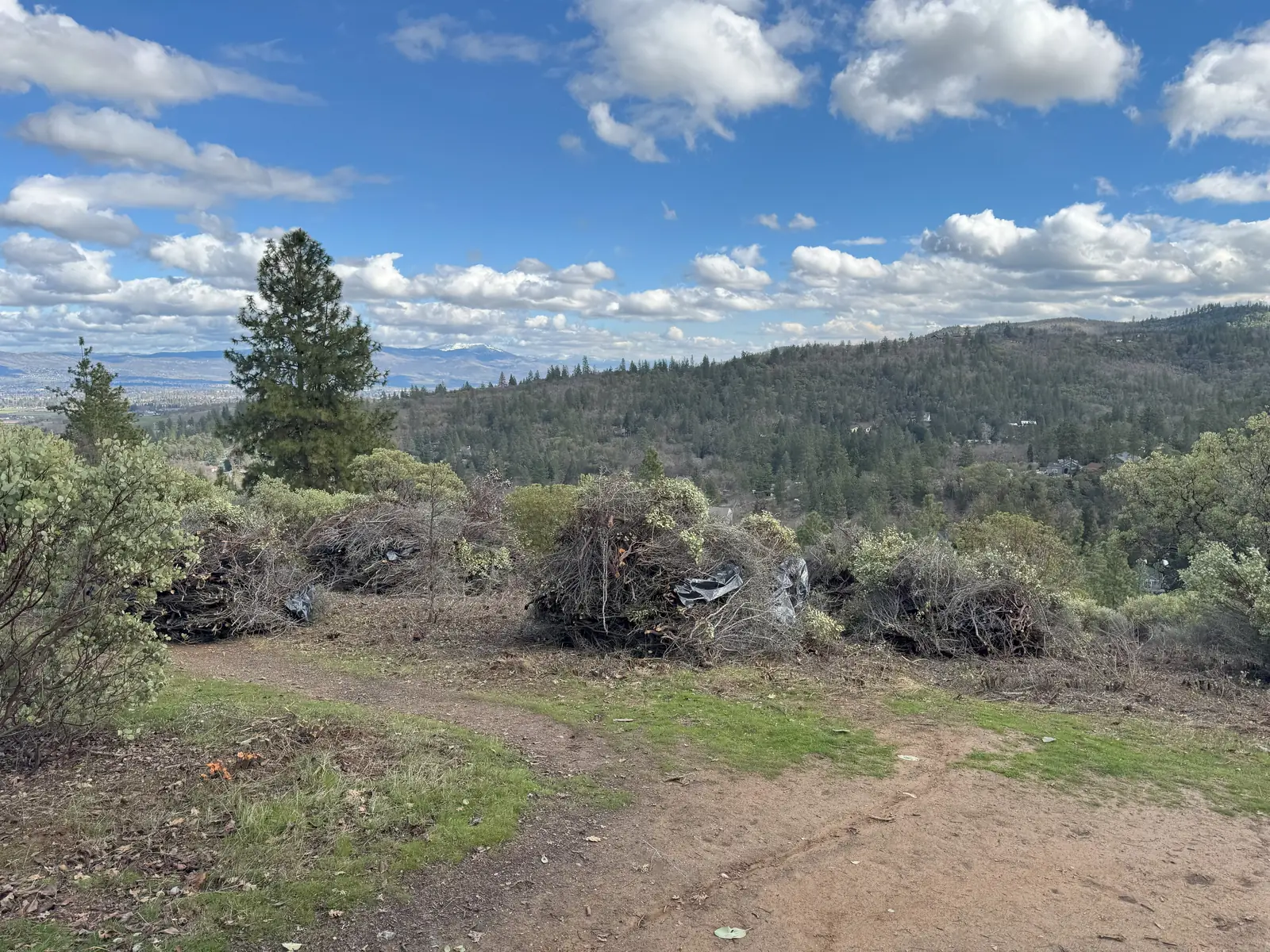
Around a house on rural land, the fuel we clear is grass, brush, blackberry and small trees. Defensible space clearing cuts that growth back from homes and outbuildings. Our skid steer and excavator both run forestry mulcher heads that grind brush and small trees into mulch in place. A brush mower on the skid steer takes down tall grass and heavy weeds.
What did SB 83 change?
Senate Bill 762 set up Oregon’s wildfire program in 2021, and Senate Bill 80 made changes in 2023. The Fire Marshal’s model code says SB 83 amended both to reflect local flexibility rather than statewide enforcement.
SB 83 also voided the State Forestry Department orders that had assigned property to a wildfire hazard zone. The old law had the Fire Marshal set minimum defensible space requirements for areas on the statewide map. SB 83 took that language out.
Instead, the law has the Fire Marshal create a model code and make it available to local governments. Its standards must line up with, and not exceed, the defensible space standards in the 2024 International Wildland-Urban Interface Code.
What does the model code require where it is adopted?
The model code applies only where a local government adopts it. Then it covers buildings in the areas that government designates as wildland-urban interface. Oregon law describes that as a cluster of homes in an urban or suburban setting near wildland.
Where it applies, whoever owns or controls the property is responsible for the vegetation work. The code sets these zones and distances:
| Zone or rule | Distance | What the model code asks for |
|---|---|---|
| Noncombustible zone | At least 5 feet around buildings, decks and other development | No burnable plants, needles, leaves or bark mulch. Gravel, concrete and bare dirt are allowed. |
| Moderate hazard area | Fuel modified out to 30 feet | Less vegetation, or plants that carry less fuel |
| High hazard area | Fuel modified out to 50 feet | The same fuel work, farther out |
| Extreme hazard area | Fuel modified out to 100 feet | The same fuel work, farther out again |
| Existing trees | Crowns at least 10 feet apart | Trees can stay, with the same spacing from buildings and power lines |
| Trees taller than 18 feet | Limbs lower than 6 feet | Pruned off |
| Your property line | The distances stop there | No requirement past your own lot line |
Fuel modification means reducing the amount of vegetation or changing what grows there. The local government sets the hazard level for each area.
Deadwood and litter get removed on a regular basis, and so does ladder fuel. Ladder fuel means branches, leaves, needles and other growth that can carry fire from low plants into taller ones. The local code official may inspect to check compliance.
Limbing and pruning trees is arborist work, and it is not ours. Our machines take grass, brush, blackberry and small trees.
How do you find out if a local code covers your property?
Ask your city or county planning department, or your fire district. Whether a local code applies depends on where your property sits. Rules typically differ from one city, county or district to the next.
The model code’s code official is local, such as a planning department, city, county or rural fire protection district. A local government that starts the adoption process has to notify the State Fire Marshal. Enforcement and appeals under an adopted code are handled locally.
OSFM calls the model code a baseline that can be expanded to meet local needs. So a local version can differ from the table above.
Is there a separate rule for new homes in forest zones?
Yes. Oregon’s fire-siting rule, OAR 660-006-0035, is separate from SB 83. It applies to new dwellings and structures in forest and agriculture/forest zones.
Owners of those homes keep a primary fuel-free break around all structures. They also clear and keep a secondary fuel-free break on land around the house that they own or control. The house may not sit on a slope steeper than 40 percent.
The rule points to Oregon Department of Forestry fire siting standards for how the breaks are laid out. Ask the county planning department what that means for your parcel. A new homesite can bring other permits too, and our guide to land clearing permits in Oregon covers them.
What do Oregon landowners do anyway?
You can follow the State Fire Marshal’s guidance whether or not a local code applies. OSFM splits the ground around a home into three zones:
- 0 to 5 feet, the immediate zone
- 5 to 30 feet, the intermediate zone
- 30 to 100 feet and beyond, the extended zone
Within 5 feet of the house, OSFM calls for river rock, gravel or pavers. Bark mulch and flammable plants come out of that strip.
Mow the grass. OSFM says to keep grass mowed to less than 4 inches. On a field that has grown up tall, brush hogging cuts it down first.
Clear the brush under trees. OSFM calls this removing ladder fuels. Brush clearing takes that undergrowth out with the skid steer and excavator.
Space the trees. OSFM wants tree crowns at least 10 feet apart. Where small trees crowd together, forestry mulching grinds the extras into mulch where they stand. Pruning trees up 6 feet from the ground is on the list too, and that part is arborist work.
Clear around the propane tank. OSFM asks for 10 feet of clearance around propane tanks. Keep grass and brush cut back inside that ring.
Open up the driveway. OSFM calls for driveways with 13 feet 6 inches of vertical and 20 feet of horizontal clearance for fire engines. Driveway and access road clearing opens up the width where brush has closed in. Limbs hanging over the drive are work for an arborist.
OSFM also offers free defensible space assessments. The visit is education-focused and gives property owners tips to start or improve their defensible space.
How do you get defensible space clearing started?
Start by asking your planning department or fire district whether a local code applies. This guide is general information, not legal advice.
Then look at the fuel around your buildings with the three zones in mind. When the grass, brush, blackberry and small trees need to go, see our defensible space clearing service. Estimates are free. Call or text (541) 936-4687.