Forestry Mulcher vs Brush Hog: Which One Does Your Land Need?
A brush hog is for grass, weeds and light brush. A forestry mulcher is for woody brush and small trees. If your field is tall but still soft-stemmed, hire a brush hog. If the stems have turned to wood, hire a forestry mulcher.
The forestry mulcher vs brush hog choice comes down to what is growing and what the ground is for. One contractor pricing guide puts a brush hog’s limit at about 2 to 3 inches. We run both machines, so we fit the machine to your ground.
What is the difference between a brush hog and a forestry mulcher?
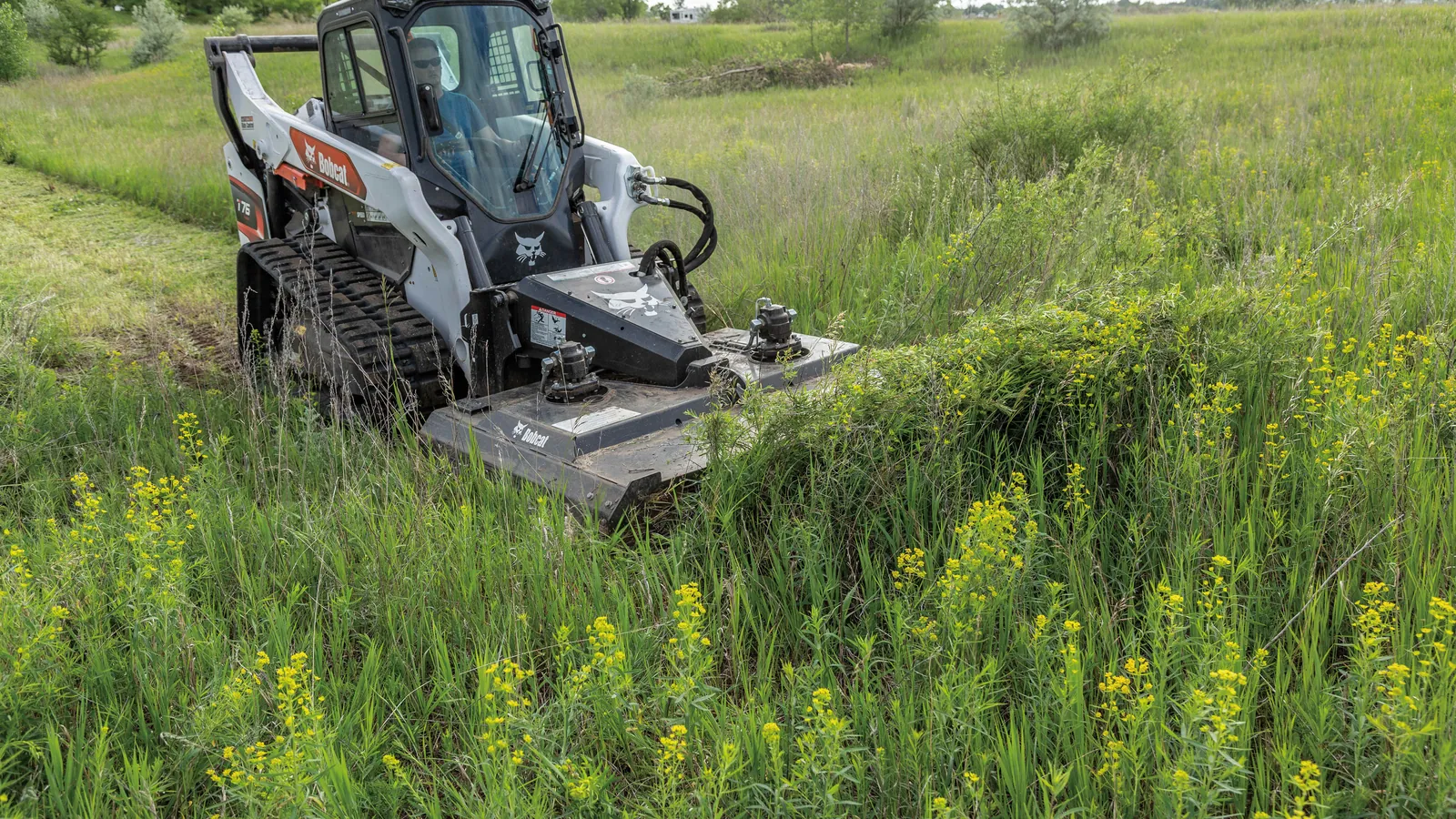
A brush hog is a heavy rotary mower, also called a rotary cutter. A lot of people just say bush hog. Spinning blades under a deck cut the growth and drop it. Our brush hogging and field mowing work runs a heavy brush mower on our Bobcat skid steer.
A forestry mulcher grinds instead of mowing. One common type uses a rotating drum with bladed teeth to make a fine mulch. Brush and small trees turn into chips right where they stood. We do forestry mulching with a mulcher head on the skid steer and a mulching head on our excavator.
How does a brush hog vs forestry mulcher compare?
| What to compare | Brush hog | Forestry mulcher |
|---|---|---|
| Best for | Grass, weeds and light brush | Woody brush and small trees |
| Stem size | Up to about 2 to 3 inches | Thicker stems and small trees |
| What it leaves | Short stubble and laid-down grass | A layer of wood chips |
| Market pace | 2 to 5 acres of light brush per day, with a tractor | 1 to 3 acres per day, on a skid steer |
| Market cost | $150 to $600 per acre, one pass on light growth | $400 to $800 per acre on average, up to $2,000 for dense overgrowth |
The pace and cost rows are market numbers, not our price list. The brush hog side comes from a contractor pricing guide, the mulcher side from HomeGuide, a national cost guide. HomeGuide also lists forestry mulching at $125 to $300 per hour.
No single guide settles it. Other guides run higher on mulching, and farm custom rate surveys run well below that mowing figure on open pasture. The contractor guide calls a brush hog the fastest and cheapest method for light brush. Our brush hogging cost guide lays out mowing rates by the acre and by the hour.
How thick a stem can each machine cut?
Height rarely stops a brush hog, but thickness does. The contractor guide says it handles vegetation up to about 2 to 3 inches in diameter. Anything thicker can jam the mower, damage it or get pushed over instead of cut.
A forestry mulcher picks up where the mower stops. The same guide says a brush hog cannot handle thick blackberry canes and small trees up to 4 inches effectively. For trees in the 4 to 8 inch range, it calls for forestry mulching or excavator clearing. Mature timber and hazard trees near buildings are outside what we do.
What does each machine leave behind?
A brush hog leaves short stubble. The cut grass and weeds drop and settle into the ground they came from.
A forestry mulcher leaves a layer of wood chips. How deep it sits depends on how thick the growth was. HomeGuide says the mulch layer decomposes to improve the soil.
Neither machine pulls stumps. If the ground has to carry a building or a driveway, the stumps need to come out. Our forestry mulching vs land clearing guide covers that choice.
Will the growth come back after either machine?
Yes. Both machines cut the top and leave the roots in the ground. The contractor guide says regrowth after a brush hog usually comes within one growing season. Mulched ground grows back too, so some regrowth is normal.
Regrowth control on our jobs means repeat mowing and repeat mulching. A spring pass and a late summer pass keep most fields in shape. Blackberry is the hard case, because cutting the canes alone does not kill it. That ground usually needs blackberry removal and repeat passes.
How do wet ground, slopes and rocks change the choice?
Soft ground limits both machines. West of the Cascades, about half the year’s precipitation falls from December through February. Valley clay loam stays soft into spring, and winter fields rut easily. We time the work around how soft the ground is.
Slopes favor the excavator. Our skid steer works gentler grades with either the mower or the mulcher head. On steeper banks, our excavator sets up on stable ground and reaches out with its mulching head. That work is hillside clearing.
Rocks can damage a mower, and rock does not go through a mulcher head either. Tight corners and fence lines often suit the excavator, because its arm reaches in.
Do fire season rules change the plan?
They typically change when a machine can run. On forestland, the Oregon Department of Forestry sets Industrial Fire Precaution Levels, or IFPL. These levels typically restrict ground-based equipment like skid steers and excavators. At IFPL IV, all operations are typically prohibited.
Dry grass adds its own risk, because a mower blade hitting a rock can start a fire. We check the current level and plan the job around it. Fuel work around a home falls under defensible space clearing.
Which one does your land need?
- A field two seasons behind. Hire a brush hog. Tall grass and heavy weeds come down to stubble in one pass.
- A fence line. Grass and weeds along the wire are mower work. Woody brush in the wire calls for a mulching head on our excavator.
- Blackberry mounds. Light canes mow. An old mound needs the mulcher head first.
- Young fir and broom on old pasture. Hire a forestry mulcher. OSU Extension’s northwest Oregon wildfire fuels guide names Scotch broom and blackberry as two of the most common invaders.
- A place that needs both. The mulcher works the woody ground and the mower takes the grass. One visit can cover both.
Mower first or mulcher first? Mulcher first on woody ground, because a mower cannot take those stems. The mower comes later to hold the ground open, and HomeGuide lists that as a common step. Thick brush across back acreage usually falls under brush clearing.
Where does a flail mower fit?
A flail mower is a third tool people compare with these two. It spins a shaft lined with small knives or hammers, where a brush hog spins big blades. HomeGuide names a flail mower next to the bush hog for mowing regrowth after forestry mulching. We do not run one, so our jobs use a brush mower or a mulcher head.
How do you find out which machine your land needs?
You do not have to pick the machine yourself. We run both, so we look at the growth and the ground, then tell you which one fits. Estimates are free across the mid-Willamette Valley from our base in Lebanon.
If your ground is mostly grass, weeds and light brush, start with brush hogging. If you are weighing a rental instead, read forestry mulcher rental vs hiring. Call or text (541) 936-4687.